FanDuel’s US business made $3 million in adjusted EBITDA in the third quarter, down 94% from a year earlier. That’s on $1.45 billion of US revenue, up 6%, with handle up 13%, average monthly players up 9% and FanDuel still the US market leader. The sportsbook grew, and almost none of that growth reached the bottom line.
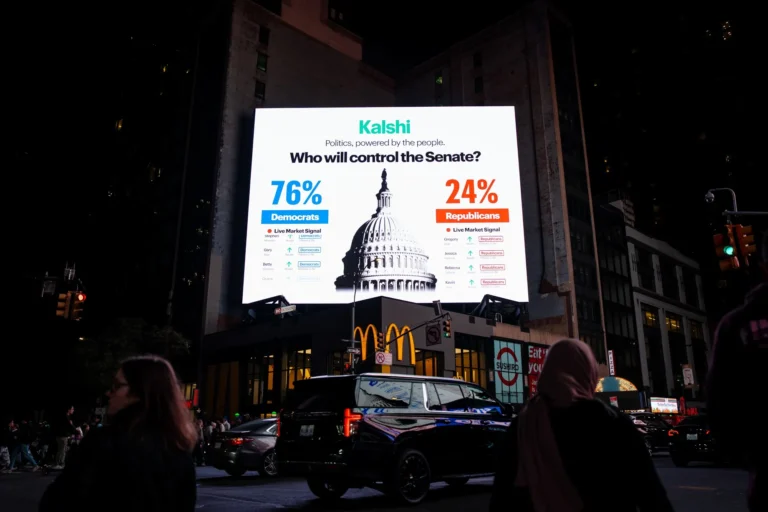
Most coverage will focus on the guidance cut. I’m more interested in where the profit went. Flutter says it went into prediction markets and the Alberta launch. FanDuel Predicts handled $119 million in the entire quarter. Kalshi did about $3.9 billion in notional volume on one Saturday in October. FanDuel is spending heavily to compete in a market where it’s still very small.
Key Takeaways
- FanDuel US: Revenue up 6% to $1.45B (sportsbook +4%, iGaming +8%), but adjusted EBITDA down 94% to $3M.
- Flutter group: Revenue up 2.1% to $3.87B, missing consensus of about $4B, and a net loss of $1.15B.
- Brazil: An $873M non-cash impairment from Lula’s betting ban.
- Guidance: Revenue cut $300M to $17.61B, and adjusted EBITDA cut $160M to about $2.49B. Share buybacks are paused.
- FanDuel Predicts: $119M in Q3 volume (+102% on Q2), 140,000 active users in October, and October volume up 271% on July.
- Stock: Flutter shares are down more than 60% this year.
Flutter Q3 2026 by the Numbers
| Metric | Q3 2026 | Change |
|---|---|---|
| Group revenue | $3.87B | +2.1% YoY (consensus ~$4B) |
| US revenue (FanDuel) | $1.45B | +6% |
| US sportsbook revenue | — | +4% |
| US iGaming revenue | — | +8% |
| US handle | — | +13% |
| US average monthly players | — | +9% |
| FanDuel Casino average monthly players | — | +24% |
| US adjusted EBITDA | $3M | –94% |
| International revenue | $2.42B | Flat |
| International adjusted EBITDA | — | –14% (UK tax rises) |
| Brazil impairment | $873M | Non-cash |
| Group net loss | $1.15B | vs. $789M prior |
| 2026 revenue guidance | $17.61B | Cut $300M |
| 2026 adjusted EBITDA guidance | ~$2.49B | Cut $160M |
Sources: Flutter Q3 release via Covers, Front Office Sports and Gambling Insider.
Where FanDuel’s Profit Went
Flutter’s explanation is clear. US adjusted EBITDA fell because the company “invested more into its prediction market product” and launched in Alberta. Taylor said that while prediction markets still have little effect on sportsbook activity, they’re pushing marketing costs up across the industry.
“The duration of this trend will depend in part on how the regulatory landscape develops, but at this early stage, we expect our marketing intensity to continue in 2027 at levels similar to this year,” Taylor said.
So the higher spending is expected to continue next year.
FanDuel Predicts vs. Kalshi
New CEO Dan Taylor, in his first quarter since taking over from Peter Jackson on Oct. 1, was candid. FanDuel Predicts, which launched late last year, “was not competitive” until recently.
“The results we’re seeing are very good,” he said. “We’ve really only been live at scale since the start of the NFL season.”
The growth rates are strong. The overall size is still small.
| Metric | FanDuel Predicts | Kalshi |
|---|---|---|
| Volume | $119M (all of Q3) | ~$3.9B (Sat., Oct. 11 alone) |
| Growth | +102% QoQ; Oct. up 271% vs. July | Record weekends through NFL season |
| Users | 140,000 active (October) | — |
| Valuation | Part of Flutter (shares down 60%+ YTD) | ~$40B (latest private round) |
Note: Kalshi’s figure is notional volume from TickerTracker, so the two numbers aren’t measured exactly the same way. The difference in scale is still very large.
Flutter has another route in. Its market-making business provides liquidity on other exchanges, and Barron’s reported in September that this includes Kalshi. Taylor called market making “really at the heart of Flutter’s capabilities” and “a really exciting near-term revenue and profit generator.” J.P. Morgan was less convinced: “it doesn’t seem that market making drove any real upside” in Q3.
Brazil: The $873 Million Write-Down
The largest single item was Brazil. Flutter bought NSX for $350 million in 2024 and took a 56% stake in Betnacional, aiming for an 11% share of a market Lula has now shut down. The $873 million non-cash impairment accounts for most of the $1.15 billion net loss.
Taylor said Flutter is “backing off its full-year guidance because of the Brazilian market impact.” With Lula re-elected and saying “betting won’t come back,” Flutter isn’t counting on a quick return.
“Limited Impact” From Prediction Markets
Taylor’s main argument to investors was that prediction markets aren’t taking FanDuel’s existing customers.
“We continue to see a limited impact from prediction markets on the betting activity of our existing customer base, which I believe, and our consumer research affirms, reflects the superior proposition offered by sportsbooks,” he said.
The handle and player figures support that. But if prediction markets weren’t a threat, Flutter wouldn’t have spent most of its US profit competing with them. The threat isn’t that customers are leaving now. It’s that Kalshi is signing up a generation of bettors in states where FanDuel can’t operate a sportsbook, and FanDuel has to pay to be there too.
Taylor also said FanDuel was “disappointed” after Nebraska voters rejected online sports betting on Nov. 3, but said “we feel good” about a “strong pipeline of further state openings.” Currently 39 states plus DC have legal sports betting.
The Analyst View
“This should be no surprise,” Jefferies wrote, noting the results were below consensus. Flutter shares still rose more than 2% on the day, which suggests investors had already priced in a bad quarter.
DraftKings reported the following day. MarketBeat shows a loss of $0.70 per share against $0.41 expected, and Front Office Sports reports DraftKings made at least its third round of layoffs this year before the report. TIKR noted DraftKings shares had risen about 14% in the week after Flutter’s report, as the market took Flutter’s “limited impact” comment as good news for the whole sector.
What I’m Watching
What I keep coming back to is the cost of competing. FanDuel is the largest US sportsbook, growing handle 13% and players 9%, and it earned $3 million in Q3 because it had to spend to compete with a company that pays no state gaming tax. Kalshi doesn’t need to win FanDuel’s customers to hurt FanDuel. It just needs to keep raising FanDuel’s costs.
Add Brazil, the UK tax rise and 1,400 job cuts, and Flutter’s Q3 shows the main pressures on the industry in one report: regulators can ban you, tax you or allow a rival with lower costs. Flutter is dealing with all three.
FAQ: Flutter Q3 2026 Earnings
How did FanDuel perform in Q3 2026?
US revenue rose 6% to $1.45 billion, led by 8% iGaming growth, but adjusted EBITDA fell 94% to $3 million because of prediction-market spending and the Alberta launch.
Why did Flutter post a $1.15 billion loss?
Mainly because of an $873 million non-cash impairment on its Brazil business after Lula’s government banned online betting, plus higher marketing costs and UK tax increases.
How big is FanDuel Predicts?
It handled $119 million in Q3, up 102% from Q2, and had 140,000 active users in October, according to Flutter.
Did Flutter cut its guidance?
Yes. Flutter cut 2026 revenue guidance by $300 million to $17.61 billion and adjusted EBITDA guidance by $160 million to about $2.49 billion, and paused share buybacks.