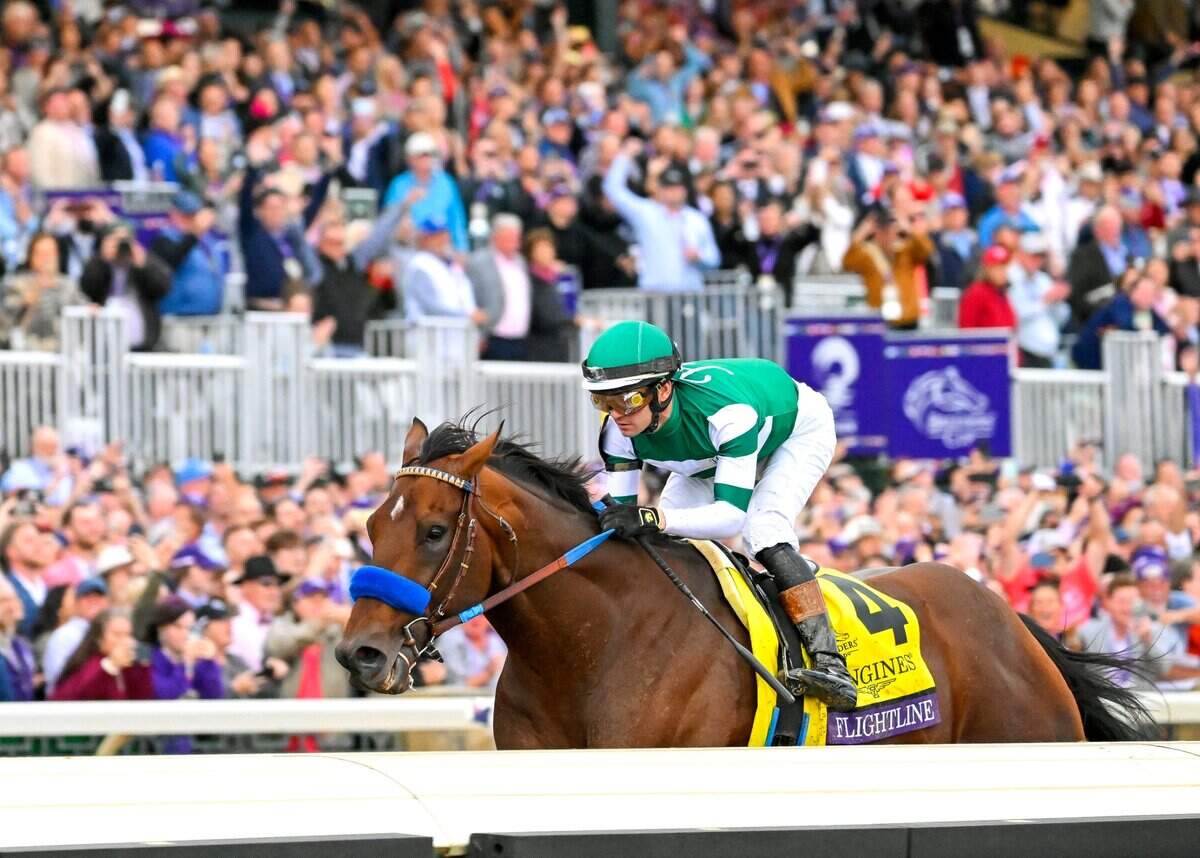
Back in 2022, punters wagered around $189 Million at Keeneland, the most for any Breeders’ Cup ever. On Oct. 30–31, the event returns to Lexington for its 43rd running, with 14 championship races and about $34 million in purses and awards. Last year’s handle was $180,036,799, the third-highest ever. The racing will get most of the attention. I’m more interested in whether this weekend can push against a trend that has been running against racing all year.
The Classic is a strong matchup. Sovereignty, trained by Bill Mott, leads the Longines Breeders’ Cup Classic rankings with 383 votes and is the betting favorite at +300. Japan’s Forever Young, last year’s Classic winner, is close behind with 363 votes at +400. Pacific Classic winner Knightsbridge, Magnitude and Golden Tempo round out the top five. There’s one question mark on the favorite. Sovereignty only recently returned to training after a hoof abscess, so his final workouts will matter. On the filly side, Nitrogen arrives off an easy Beldame win. A rematch between the defending champion and the Horse of the Year is the kind of race that brings casual bettors back, and racing needs those bettors badly this year.
What I keep coming back to is the gap between racing’s big days and the rest of its calendar. US handle was $7.56 billion through August, down 4.80% from last year and on pace for a fifth straight annual decline. August alone was down 6.43%, and available purses dropped 10.62% that month. Meanwhile, the best meets keep growing. Saratoga’s 2026 meets handled about $1.105 billion, up 3%. Del Mar’s all-sources wagering rose 2.3% to $546.8 million, helped by an industry-leading 8.6 starters per race. When a racing card has full fields and a big event behind it, bettors show up. The Breeders’ Cup is the biggest example of that every year, and Keeneland is where it set its handle record.
Keeneland is limiting attendance to 43,000 a day, so the size of the weekend depends on off-track and online betting, not on the crowd. That’s where the competition comes in. Prediction markets have mostly stayed away from horse racing, partly because racing’s pari-mutuel model and state regulators are hard to work around. That keeps racing’s betting pools intact, but they’re competing for the same customers. In September, prediction markets did billions of dollars in volume on single football weekends. A bettor deciding between a 20-leg parlay on an app and a Pick 6 at Keeneland is the customer racing has to win back.
Breaking the $189 million record would be a strong signal for the industry. Matching last year’s $180 million would show that racing’s biggest days are holding up while the rest of the calendar declines. A drop below $180 million would tell you the declines are spreading to the events racing has relied on to hold steady. The race calendar has already been disrupted this fall. A nor’easter forced Belmont’s six graded stakes, including two “Win and You’re In” races, to move to Oct. 1. If the weekend goes smoothly at Keeneland, racing gets two days to show it can still draw serious money.